Grassmannian Interpolation
Input to create interpolator:
Nominal airfoil (2D) shapes defining cross sections to be interpolated
Locations of these shapes along the span-wise direction (
eta)
Wind turbine blade definitions from YAML file:
Often, a wind turbine blade definition is encoded in a YAML file which contains nominal airfoil cross sections (normalized to have unit chord), their location along the blade span (eta), and profiles of pitch axis (axis of twist), pitch angle (twist), chordal scaling, and translations.
Our routine for blade interpolation consists of the following steps:
Read the blade definition from the YAML file and reparametrize input airfoils so they have an equal number of landmarks with consistent landmark distribution
Interpolate consistent shapes between given cross sections (maintain the nominal unit chord length)
Apply affine deformations to the interpolated shapes to scale, rotate, shift and bend (out-of-plane rotation) the blade according to the given profiles.
This example can also be executed and customized as a script in G2Aero/examples/blade_interpolation.py. The script also demonstrates how a user can generate a mesh with Gmsh using the resulting blade interpolation as input.
[1]:
import os
import numpy as np
import matplotlib.pyplot as plt
%matplotlib inline
from g2aero.yaml_info import YamlInfo
from g2aero.Grassmann_interpolation import GrassmannInterpolator
from g2aero.transform import TransformBlade, global_blade_coordinates
root_path = os.path.abspath(os.path.join(os.path.dirname("__file__"), os.pardir, os.pardir))
blades_path = os.path.join(root_path, 'data', 'blades_yamls')
Reading a blade definition
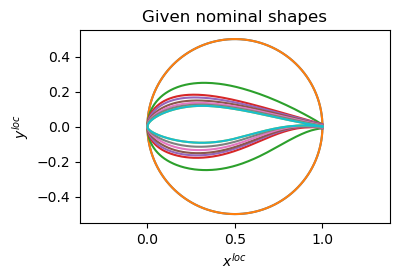
We first create a class object Blade with information from the YAML file and save Blade.xy_landmarks as 2D airfoil cross sections automatically reparametrized to have consistent landmarks. Then, Blade.eta_nominal stores the locations of the nominal airfoil cross sections along the normalized blade span positions (contained in 0 to 1) to define knots of the interpolator. Note that the number of landmarks is defined by the user and set to n_landmarks=401 in this example.
[2]:
# shapes_filename = os.path.join(blades_path, 'nrel5mw_ofpolars.yaml')
shapes_filename = os.path.join(blades_path, 'IEA-15-240-RWT.yaml')
Blade = YamlInfo.init_from_yaml(shapes_filename, n_landmarks=401)
xy_nominal = Blade.xy_landmarks
eta_nominal = Blade.eta_nominal
fig, ax = plt.subplots(1, 1, figsize=(4, 2.5))
for i, xy in enumerate(xy_nominal):
ax.plot(xy[:, 0], xy[:, 1])
ax.axis('equal')
ax.set_xlabel(r'$x^{loc}$')
ax.set_ylabel(r'$y^{loc}$')
ax.set_title('Given nominal shapes')
[2]:
Text(0.5, 1.0, 'Given nominal shapes')
Interpolation Routine
Now we can create the interpolator GrInterp using the reparametrized nominal airfoils paired with their normalized span-wise position as inputs.
[3]:
GrInterp = GrassmannInterpolator(eta_nominal, xy_nominal)
Next, we define a refined array of span-wise positions to generated new airfoil cross sections with the interpolator. We can provide any desired locations, e.g. 200 locations uniformly generated along the blade span or some alternative user definition.
[4]:
eta_span = np.linspace(0, 1, 200)
Otherwise, we can use a built-in method to generate locations uniformly over cumulative Grassmannian distances to define a novel refinement over reparametrized blade span-wise positions. This method will generate more cross sections between nominal span-wise positions when shapes have a larger Grassmannian distance between them—offering a more prudent notion of how to refine the blade. Note that this method also has arguments n_hub, n_tip, n_end, which can help refine cross
sections near the hub and near the tip in the event that the generated refinement is too sparse in these regions where structural implications are important or affine scales change dramatically. (see Technical Reference for details.)
[5]:
eta_span = GrInterp.sample_eta(n_samples=200)
Next, we pass the array of desired locations to the interpolator to get interpolated shapes. The data phys_crosssections contains the sequence of 2D interpolated shapes (3D parallel cross sectional slices positioned orthogonally to the planar directions at eta_space) with unit chord.
[6]:
phys_crosssections, gr_crosssections = GrInterp(eta_span, grassmann=True)
fig, ax = plt.subplots(1, 1, figsize=(4, 2.5))
for i, xy in enumerate(phys_crosssections):
ax.plot(xy[:, 0], xy[:, 1])
ax.axis('equal')
ax.set_title("Interpolated shapes")
[6]:
Text(0.5, 1.0, 'Interpolated shapes')

Apply Affine transformations
Finally, we apply affine transformations (independent of our interpolation) to scale, rotate, shift and bend (out-of-plane rotation and translation) the blade according to the profiles provided in YAML file.
[7]:
M_yaml = Blade.M_yaml_interpolator
b_yaml = Blade.b_yaml_interpolator
b_pitch = Blade.pitch_axis
M = GrInterp.interpolator_M
b = GrInterp.interpolator_b
Transform = TransformBlade(M_yaml, b_yaml, b_pitch, M, b)
xyz_local = Transform.grassmann_to_phys(gr_crosssections, eta_span)
xyz_global = global_blade_coordinates(xyz_local)
Last, we visualize the resulting interpolated blade. Solid black-colored cross sections represent the nominal airfoil cross sections stored in the input YAML file while the blue wire-frame represents the specified interpolation.
[8]:
import sys
sys.path.insert(0, '../')
from plot_helpfunctions import plot_3d_blade
nominal_shapes = global_blade_coordinates(Transform.grassmann_to_phys(GrInterp.xy_grassmann, eta_nominal))
plot_3d_blade(xyz_global, nominal_shapes)